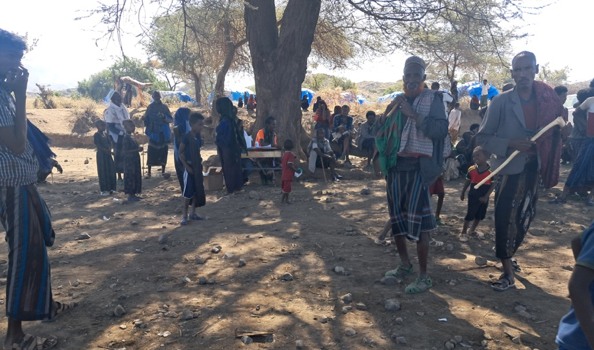
Barahale earthquake – Afar Region, Zone 2
Magaale conflict displacement – Afar Region, Zone 2
As seen and reported December 23rd to 25th 2025
1. the Earthquake
As of the first eruption on October 11th 2025, tremors are still being felt as much as 2 to 4 times weekly. Being that the devastating quake happened at sunset, miraculously only 2 deaths were incurred and almost 100 people were injured. In the ensuing fear, 117 mothers miscarried, 60 hospitalized with serious blood loss. As of the onset, 54,000 people have remained displaced having to evacuate their houses into the cold of the night with the tremors. For this reason, school is taught under a tree.
Affected areas are in 5 kebeles with Buuri and ‘Ass Gubi most seriously affected – 70% of all houses are unlivable and water sources are either sucked underground or the cistern cracked and leaking requiring water trucking where it can reach otherwise women walk up to 4 hours to collect water.
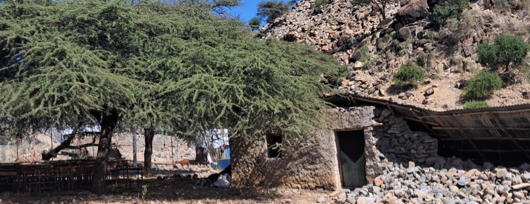
Broken classroom block and desks under the tree in Garramoyti, ‘Ass Gubi
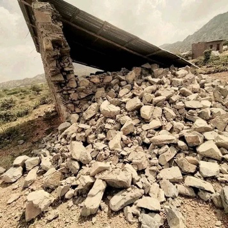
Broken classroom block and desks under the tree in Garramoyti, ‘Ass Gubi
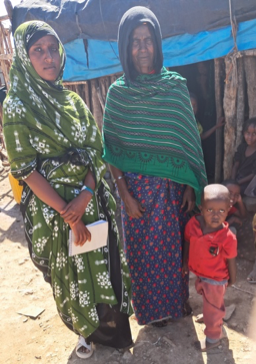
This mother’s child was pulled out of the rubble of this house on October 11th 2025
- Assistance received:
Various NGOs and government have and are supporting the community with food. APDA has conducted nutrition surveillance in November and December finding and treating 42% of pregnant/ lactating mothers are malnourished and 3.8% of under five-year old children have severe malnutrition.
Household and WASH NFIs are widely distributed along with selected cash support. A government team coordinates the efforts. Water is trucked and stored in roto storage where it is possible for vehicle reach.
- APDA community work in Barahale:
As of early 2025, APDA has a team of 10 community social workers in the affected kebeles tasked with conducting house to house support to stop GBV and support survivors. This team also implements 5 girls and women friendly spaces deep in community settings. They were in fact the first responders having raised an immediate alarm with APDA on October 11th.
While there are people in Barahale do have considerable wealth from the salt, gold finds and connections with the Arab states, there is a considerable need with women and girls due to a strong early – marriage culture that restricts females from getting divorces as needed.
- The expressed need:
Having tried to re-build houses and seen them crack with the ongoing tremors of the earthquake, the community expressed resolution to change from rock – constructed housing to that of traditional mats over a bent frame of locally – available thin branches. It is very cold at night and currently several families are sharing one dwelling.
It is then suggested that
- An initial group of particularly poor households are supplied with 15 traditional mats as bought through local cooperatives
- Women are set up with the raw material of dry palm leaf/ ‘unga to go on making their own mats, selling them to the community and to further markets. This is available in southern Eli Da’ar and in Afdeera. This could develop into a strong, women-led market supporting these needs in other rural woredas since this is the traditional need of any Afar household, mats lasting up to 3 years before they need replacement and the house being conical does not blow in the wind and is portable to take when migrating with the herd.
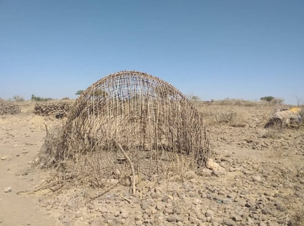
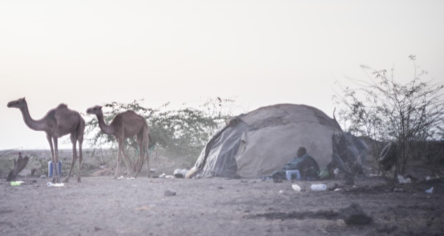
The frame of the traditional house and the house
2. Conflict displacement
As of the evening of November 5th 2025, when two armed forces broke out in physical conflict in the Magaale kebele of Tonsa, 18,111 people fled with what they could grab into safety. These people remain displaced in 3 rural settlements close to the Kutkuti River valley. Having received plastic sheeting and some household implements, they have erected conical – shaped frames resembling their traditional houses. As guns were firing 4,298 goats in total from Tonsa and adjoining ‘Aadu fled in fright along with 421 camels, their fate unknown as to whether the combatants confiscated them or hyenas ate them.
They live in crammed settlements on relatively dry land: 1,416 households all from Tonsa in Aroori; 882 households in ‘Eela Kalo partly from Tonsa and also adjoining ‘Aadu kebele and 721 households in Kutkuti from ‘Aadu, a total of 3,019 displaced households. There is a trickle of water in the riverbed covering their water needs.
While it is said one of the Tigray warring factions has retreated into Tigray – some say a few remain – there is no certainty and till now, no confirmed thinking that these displaced people are about to return to their original settlements. The startling thing is to see them as herdsmen without a single goat or donkey visible in the displacement areas just sitting and waiting.
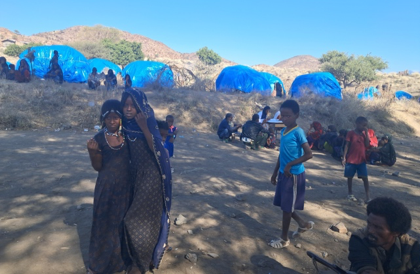
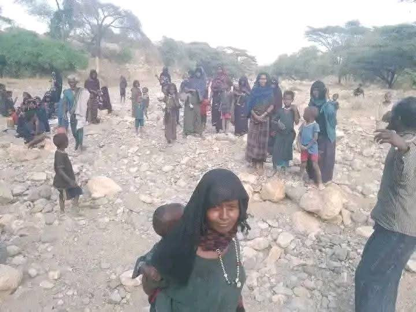
Aroori displacement camp
Assistance received:
First the government giving some dates and rice, APDA distributed 375 quintal of wheat flour within 4 days of the incident along with supplementary food for malnourished mothers and 70 quintals of lentils along with blankets and cold-weather clothes as collected locally.
Two NGOs have distributed WaSH and household NFIs as well, an NGO is supporting government mobile health team to conduct basic treatment support. Along with the other kebeles of Magaale, APDA mobile health team has conducted nutrition screening, treating identified cases as well as supporting maternal health care. Aside from the scant amount of food APDA provided there has been no further distribution although beneficiaries have been registered for WFP food through CRS.
Expressed current needs
Number one is FOOD. Daily they are now very hungry. While immediate sustenance is needed until the distribution under WFP starts, if there is supplied concentrated animal feed for 3 to 5 goats per household of their remaining herds, they can get milk. Their entire remaining animals are grazing some distance away from the displacement camps. This then would also require veterinary support to prevent disease spread in such a concentrated populated area.
Again, there are 780 households left with no goats (count undertaken by Magaale pastoralist desk and APDA), their entire herd having been lost during the actual conflict and the process of fleeing/ displacing. These households need to be restocked with a minimum of 5 breeding goats: one male and 4 females (10 is more secure), animals having been purchased as locally as possible.
Too the women of Tonsa are all traditionally able to make mats. Given the raw material of dry palm leaves, they can weave mats for housing for their own consumption and sale giving them a more appropriate house than that covered with plastic tarpaulin.