According to world reports, an historically strong, potentially record-breaking El Niño is rapidly developing in 2026, with an 80% to 90% probability of persisting through at least late 2026 and into 2027. Local people are comparing the scenario to the famine of 1984/85 in terms of severity: already life-threatening thirst is reported and herds from thousands of households are on the move toward riversides if they can make it but the water in the Awash River for example is now extremely low. What we are to expect is either a total failure of the July to September expected rainy season or over abundance leading to extreme flash-flooding and flooding of the entire Awash River system. Whichever way, the Afar community in a status of utter food insecurity and malnutrition are already weakened to the highest vulnerability. Another telling issue is that as of now, rain that normally graces the southern Afar first still appears far off: clear skies in the daytime and very thin veneer of clouds in the early morning. Temperatures are unrelenting: 36 degrees at sunrise and then 41 to 45 degrees all day.
- Already, a broad figure of 50,000 people is declared in danger of dying of thirst. They are now skimming utterly dirt-filled water from remaining water points; the community going for as long as 24 hours with pack-animals to find water.
- Entire households with their herds are migrating toward to Awash River Basin in search of water and grazing pasture. As they crowd along the banks, communicable diseases in humans and animals will readily transmit.
- Malnutrition among children and pregnant/ lactating mothers is soaring: from 13 remote communities APDA mobile health teams surveyed in June, over 8,200 malnourished mothers were identified (risen from 6,430 in April/ May) with an average of 44.87% of those screened actually malnourished. Buurimudayto in the Middle Awash where communities are market-isolated and totally herd – dependent, 76.61% of mothers are malnourished. In Afdeera, notoriously known as the Danakil Depression or ‘hottest, inhabited place on earth’, maternal malnutrition has peaked to 62.48% in communities without road access.
- While the actual selling price of goats has eased higher, the herd is now highly weakened. While a strong goat may purchase wheat flour to support the family for 10 to 15 days; up to 3 weak goats are needed for the same transaction. IF no rain falls in July, the goats will no longer be saleable.
- Regular market inflation in town shops is around 25%. However, the competitive, informal market is as high as 54%. Six weeks ago, a 50 GM bar of soap was 50.00 ETB, now 70.00 ETB. This has pushed the community into negative coping mechanisms of eating once daily and limiting commodities to that of negligible nutrition.
- Fuel cost is 1.13 USD per liter compared to 0.95 USD in USA. General information speaks of further rises to be expected as the Ethiopian government fully removes the subsidy from it, increasing taxation.
- Unrest is ever-present, ever threatening: compulsory conscription to army service in Tigray the greatest indicator that the path of peace is not being pursued. Military camps among the Afar communities and displacing them are yet another factor the household must deal with on a daily basis.
- Current lack of available resources: Ethiopia Joint Emergency Operation Program through WFP providing food basket to displaced and drought – affected populations comes to an end as of July 2026 with no apparent replacement. Moreover, being the end of one Ethiopian year and the beginning of the next, most local governments have no funding until September, the New Year to support their own people.
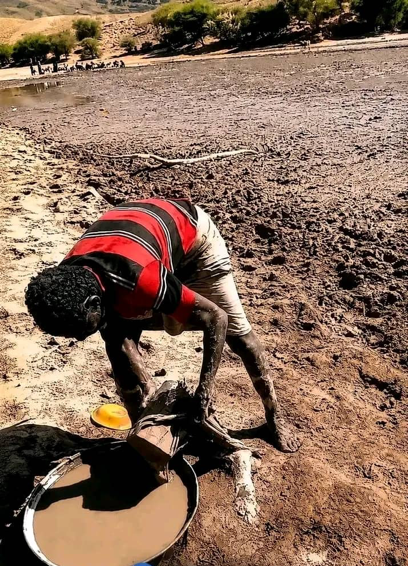
Normally an oasis for around 10,000 households and their herds is all but dry. This man has scooped up drinking water from the remaining water seen in the upper right-hand corner of the photo. APDA constructed this dam known as Galada 36 kms from the start of the road to Afdeera in 1999. Photo taken July 9th 2026
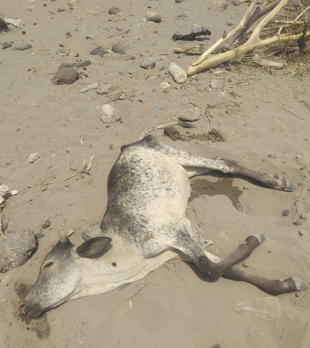
A fresh casualty – the beginning of a probable many
Our challenges verses solutions
The hardest reality we in APDA are deemed to live with is that our longing is for the Afar society to march ahead to self-sufficiency yet the reality of the day calls us to address the multiple crises the communities are imbedded in. Our hope is always to address these issues through the community lens that they are directors and decision makers, if not actual contributors to their own solutions.
- Thirst and water-trucking:
Through the generosity of friends, APDA recently acquired a second-hand 25,000 liters water tanker. It is now making short rescue trips but to assist the already identified 50,000 people, 79,300 Euro/ 102,162 AUD/ 73,161.79 USD or 54,000 Sterling pounds are required that each of the 50,000 people get 5 liters of water daily for 60 days, amounts calculated according to distance. This pays for fuel and truck lubricant to reach these known communities using APDA’s truck and possibly three government trucks from the affected districts, these local governments now not having funding till the Ethiopian New Year in September.
- Supporting strategic breeding goats from dying
Thanks to the concentrated animal feed production plant APDA is activating centrally in Logya, Afar Region, the organization does have animal feed. The option the organization prefers to take is that the herdsman plans for the time when his/ her herd has insufficient grazing substance for the animal to produce milk and reproduce, purchasing from APDA’s production plant at cost price. However, in the case of emergency when the household is unable to purchase, the feed is given free, the animals also veterinary serviced. There is currently a reserve of 1,000 quintals. The need then is for fuel support to truck out the animal feed as well to replenish veterinary medications given the now accelerating animal disease outbreaks.
- Avoiding the consequences of malnutrition
While the means to treat severe acute and moderate malnutrition is available, APDA health team currently only has support to reach 30% of the geography they need to walk through to screen and treat those identified. In all cases, a team of health workers must walk for around 15 days each month treating remote house to house. Their closest health institution maybe more than a week’s walk away. The health team does refer the complicated cases but in order to endure the 15 – day walk, they need daily substance.
- Challenging inflation
APDA is making soap at a cost almost 50% of the market price and has trucks to support local food cooperatives to move bulk purchases into their respective communities. The government has somewhat relieved the trucking crisis to northern Afar Region by allocating northern Afar district governments a given amount of fuel that they can purchase at the center at lower cost. However, there are periphery communities that still cannot benefit due to their extraordinary remoteness.
UN OCHA has just published an account of the 2023/24 Eli Nino – its double face of drought in Afar Region and floods in Southern Ethiopia: https://ochaethiopia.exposure.co/the-two-faces-of-el-nino-in-ethiopia
Struggling to revive education
In full belief that social and economic development cannot happen without the intellectual development of the society, APDA is currently brain-storming on how to involve all stakeholders toward teacher – enablement. Learning has become a sterile process, the blackboard the central tool.
Taking the season of extreme heat to re-train organization teachers, first, with the Bureau of Education, Samara University and the one and only Afar teachers’ college, a new and creative way of training the program rural teachers to inspire learning is underway. This, along with the creativity of Afar reading books and learning material is a starting lock to revival.
What is extremely encouraging is the results gained for the 138 odd hostel students APDA has. Just recently, two students who had been among the 3 students who passed grade 12 in 2025 gained scholarships to study health science in India. These students have deliberate tutors and they are highly motivated as, being far from their home, their goal is to graduate to tertiary learning to serve the community they love.
