Fuel costs/ no transport equally market impossibility
While this resounds as a ‘wolf cry’, the reality is that it isn’t: it is now well over year that the northern/ NW border Afar have lived under the cloud of war bringing their lives to the stalemate they are now in. Northern Afar is almost bereft of transport: fuel costs rose in central Afar by a further 18 ETB to 175 ETB per liter, this being in the government – planned increasement to eventually reach 300 ETB/ liter. This fuel at the pump is rationed and almost unattainable, trucks stopping weeks to fuel in the administration capital of Samara. The alternative fuel market in jerricans is 600 to 700 ETB per liter. Going north to the western border town of ‘Aba’ala within proximity to Mekele where there is no fuel station, the cost jumps to 566 per liter and, add another 90 kilometers into Barahle, the cost per liter is 733 ETB. Prior to the Gulf War, fuel in ‘Aba’ala town was 183 ETB per liter, again sold in jerricans.
Then food costs follow the trend: measuring on 50 kg of wheat flour lasting a 6 – person house for around 10 days, cost has jumped from 5,400 per sack to 7,500 per sack and, as with the fuel, increasing going further north to the Eritrean border. Being the goats have just come through drought, it takes 2 to 3 goats to secure a sack. But this is not all, to actually get the animals to the town market takes a minimum transport and feeding cost of 3,500 to 4,000 ETB leaving the herdsmen’s pocket utterly empty. Then the challenge of getting a buyer looms as markets are all but bereft of the known buyers under this current isolation.
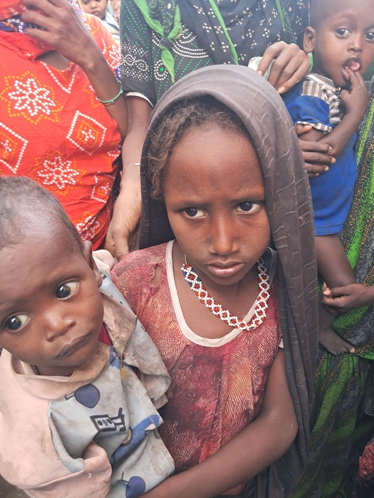
Thus the awful reckoning the government through the Ethiopian Nutrition Coordination Unit published this month: of the entire Region, only 2.6% of children eat a minimally acceptable diet to promote normal child growth; 42 to 46% of all Afar children are growth stunted; currently, 194,398 children are at risk of malnutrition (over 50% of the under 5 years population); 35 to 42% of all mothers are malnourished; 91% are folate – deficient that their baby could take on neurological abnormalities. This damming description of Afar nutrition can only be worse where APDA works and walks in the most remote areas, the government not picking up this data.
In the recent month, APDA has been shocked by the fast decline of nutrition on the Eritrean border, a district called Badda. Up until August 2024, this community of some 18,000 people were self-sufficient farming 350 hectares of riverside land over the past 150 years. Their beloved Badda River, an historic first flooded and swept away all they had, changing its channel as it went. The community then resolved to work at being merchants but again in July 2025, wind and fire destroyed the market they had built and its entire contents. Now the community mothers and small children are among the worst – malnourished in the Region, exacerbated by their geographic isolation – a bad road from Barahle to this small district takes 8 hours to cross 56 kilometers. They ARE the most distant in the Region.
The weather: its blessings and challenges
Of the Region’s 2 remaining rainy season, the short rains of March – April are lapping over a bit into May but typically relief is localized geographically and with the temperatures climbing into the 40’s, evaporation is very high, the pasture hardly having time to sprout. Acacia trees have turned green in some places but since it is summer, they are quickly flowering. Overall, there are still pockets of strong, unresolved drought and in all, this will not give strong herd recovery to household milk and breeding.
Solutions at hand and those that need support to materialize
Taking into consideration all challenges, whether natural or manmade including the coming Federal elections on June 1st APDA foresees the following:
- Community priority needs
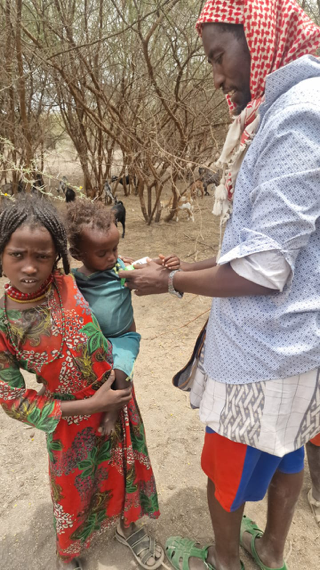
- Ongoing assistance to children and mothers with acute malnutrition through nutrition screening to identify those affected and immediate treatment with monthly follow-up
- Food in the community at a reasonable, stable price
- Access to health care, particularly for delivering mothers and acutely ill people
- Support to maintain a productive, healthy herd
- In the event of displacement due to conflict, food and shelter support
- With the school year closing in June, there is urgency to support grades 10, 11 and 12 students particularly in English through Afar-English books
- The means to tackle them as taken from community information and the organization recent experience
- Responding to acute malnutrition
This requires constant screening and a holistic approach, a team of 15 to 20 health workers walking house to house in the respective district. While checking the middle upper arm circumference of under 5 year old children, pregnant and first – six months lactating mothers, the health worker treats any acute illness found; provides appropriate health education; checks the progress of pregnant mothers from 6th months and refers any mother with risk in delivering in the home as well as those malnourished children with complication and unable to take oral treatment. This needs utter continuity that those identified recover to moderate malnutrition and do not slip back into severe malnutrition. There are currently 12 geographic areas that need this coverage in all far – flung corners of the Region.
Given the awful statistics of maternal anemia as well as almost total lack of folic acid, the organization is beginning a campaign of giving spinach seeds to a household, showing them how to grow the seeds with little water that some of this dietary inadequacy can be overcome – where ever possible, Afar need to have home gardens of banana trees and the like.
- Getting food to communities at reasonable price
APDA now has 3 trucks (2 are 50 quintals capacity and the third, 100 quintals) that are made available to community-based cooperatives facilitating them to bring supplies from wholesalers to the community without having to pay truck – rental. In the end, this reduces costs on basic commodities by around 30%, especially in the more distant, northern areas. The organization also brings up petrol barrels to the north that the lowest possible price is paid to fuel the truck. Now with the road into Tigray most likely interrupted, for the north the closest food supplies are 700 to 900 kilometers away to the south. This strategy has palpable effect in the communities from not being able to access food: almost no merchants are now moving in the northern Afar to reducing the cost by 30% since the truck-hire is taken care of. Aside from lack of food, there is mounting community stress regarding isolation from food supply.
- Keeping the goats alive and productive
APDA’s strategy combines animal treatment with concentrated animal feed in order to preserve the herd through dry seasons as well as having constant supply of milk in the house. This strategy is aimed to follow the track of malnutrition, the health worker providing immediate treatment and then, as far as it is possible, the community paying cost price for veterinary treatment and animal feed that these commodities revolve in the organization supply, as close to the community base as possible. To this end, there are now groups of community paravets (people government trained in basic animal care) who are linked to the core organization veterinarians. Both commodities APDA has to some extent: getting the community that can pay at cost price keeps basic veterinary medicines in store and with the animal feed production plant now in Logya, production is happening using locally – grown alfalfa (lucerne) and maize along with 4 other elements keeping the cost around 50% of the market price of the comparable feed. Through awareness, herders are learning to buy it through their local cooperatives that milk is available every month in the year. The addition is launching into teaching herdsmen the food the mother needs and distributing spinach seeds where households are prone to malnutrition and the mother is reproductive.
- Providing safety in health provision
This has become tenuous in that getting fuel for ambulances when it is needed is very challenging, storage of fuel also not possible due to restriction. An example was yesterday, 2 calls from ambulance within 20 minutes; in an easterly direction and the other 150 kilometers to the west; all described mothers in distress dangerously ill. With HUGE difficulty, it was managed but we live in fear of actually not making it – a referral journey may take as much as 8 hours to hospitalize her in our Mille obstetrics hospital. Too, without this referral, the fear is more fistula cases – very recently, 16 cases. In much of the landscape APDA implements maternal health, the community must carry the mother on a homemade stretcher for some hours to reach ambulance access.
- In the event of displacement due to conflict, food and shelter support
While there is currently no new displacement, given the unresolved and deepening disputes between the parties of Tigray, this is expected, whether before or after the June 1st elections. Four of the 9 northern districts have established community committees in the face of this threat to identify and support the most vulnerable. The most exposed to high difficulty includes Daalol, northern Afdeera and parts of Erebti where currently there is no food distribution or a plan for such, other districts having had their food beneficiaries as well as the ration reduced recently.
In terms of shelter, given the experience of the 2021/22 conflict when thousands of Afar houses were burnt and looted, the best is to try and forward replacement as the traditional mats the women know (Afar women are the architects as well as the constructors of their homes), that being mats women weave from the dry palm leaves of the doma palm. While
- With the school year closing in June…the need to support grades 10, 11 and 12 students particularly in English through Afar-English books
In the past 3 years, since examination is conducted under scrutiny, Afar students have scored dismally: in the 2025 exams, a total of 17 students passed to university entrance, 4,467 having sat the exam. Youth enthusiasm for education is eroding against massive unemployment and youth counter-use of social media. APDA wants to urgently print books that can facilitate student home-learning in English the learning language after grade 8. Probably the first reason for failure is little or no English comprehension. This and other means need to be put in place to rescue education as such in the Region and the country.
Vulnerability deep in Afar territory
