- Executive Summary
30 years implementation celebration!!!
- A somber realization going forward…..
Afar Pastoralist Development Association, the organ through which the pastoralist society first encountered social and economic services and secondly, the mechanism whereby the society has gone through and is going through adaptive change sees the Afar society at the height of the most critical juncture to map its way forward. Through progressive deterioration, the education system in the Region has now reached the point of failing the youth and school-aged children; food insecurity has never been worse. Afar Region now has the highest level of child-stunting (chronic malnutrition from pregnancy inception until the child is 2 years old) per head of population in Ethiopia of now over 43% fueled by persistent severe acute malnutrition in populations living remotely from government health services, the settings where APDA implements mobile social services (mobile health, education and empowerment to women and girls’ rights). The incessant mix of both natural and manmade disasters adds to the toxicity of livelihood downturn.
Confronted by this sobriety, the organization’s 5th strategic plan (2024 to 2028) is based on taking Afar people from food insecurity to security aiming that herding livelihood is secured with veterinary services and viable market while where there is adequate perennial water, Afar people grow food crops, manage the market and that food consumption is diversified. This is utterly needed realizing there are now 5 to 7 months annually where household milk is inadequate or non-existent. As well, a deliberate plan to enable Afar education promotion focusing on youth, girls and women is a strong part of the strategy. Inferring Afar language weakness plays a strong part in education failure, development and the sustainability of the language and the culture is part of the strategy, the clan leadership enabled to their rightful place of community mentoring. In the year, the following steps are made toward strategic objectives:
Food security
- APDA has taken on the principle of nutrition – sensitive agriculture, projects enabling the community to grow food and market it in very remote sites as well as extending the awareness of nutrition requirements to prevent child growth stunting.
- Now 22 community sites growing and eating vegetables and fruits stretching geographically from northern Eritrean border to central Afar, women being the primary implementers of this change. Plans and progress are underway to enable another 7 such communities in southern Afar Region to grow food crops.
- 46 women-led collaborative community cooperatives selling food and other essential commodities into rural areas, APDA supporting to cut out transport costs. Four cooperatives also working to fish and market fish from Lake Gammeri in Afambo aiming that fish becomes part of the Afar diet. A milk market value chain is also planned.
- Growth in community horticulture and marketing supported through APDA’s training center that also has a horticultural demonstration and research plot, the center now having trained and enabled 24 communities to venture into food crop production and marketing.
- Three cooperatives entailing paravets (animal treatment scouts) with their own drug vendor are treating the herd immediately and preventively.
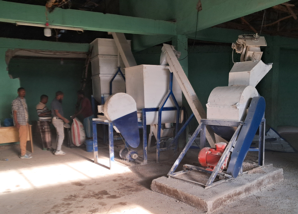
- Animal feed production plant installed and ready to operate, APDA’s social enterprise, Karma being the implementer. This aims to produce immediate drought-response animal feed as well as the community adapting to purchasing animal feed to assure and increase milk supply, making it possible to sell a fattened animal on the market.
- Emphasis given to the rescue of identified malnourished pregnant and early breast-feeding mothers in remote areas through supplementary feeding.
Afar education empowering change
- Emphasis given to women and girls learning literacy.
- Ongoing support to students learning in APDA’s 4 hostels enabling those living distant from government schools to continue learning beyond the first level primary that APDA provides in the pastoralist society.
- The now third annual conference of the Region’s senior clan leaders verifies that traditional practices that harm people must stop including female genital mutilation, the clan leaders endorsing this in their traditional law, they to punish any form of cutting.
- APDA’s printing press now producing reading and information booklets sold into the community to mobilizing home – learning and the overall sense of education.
- Daily awareness mobilizing health demands; enabling discussion to women and girls’ community rights; assuring advancement to ending harmful traditional practices and gender-based violence; household economy and market involvement.
House to house health services linked to government referrals of mothers at risk of home delivery and the APDA maternal obstetrics and gynecology hospital continue to support reproductive health aiming to reduce preventable maternal deaths.
While not expanding beyond the 37 districts of 2023 implementation and retaining its vision that ‘Afar pastoralists have adequate opportunity to enjoy basic human rights and reach their full potential’, APDA was stretched to continue social, economic and peace-building development activities as well as responding to emergency needs. With the intimate connection APDA has with these communities, emergency response was often within hours as in the case of cholera response, other disease outbreaks and that of the southern earthquake, all emergencies of 2024. As the organization is mandated, APDA continues to provide the structure for development activities where government services and other NGOs do not reach using its now well – proven and documented strategy of mobility. To that end, papers informing on how this has evolved as well as the way forward are written and available on the organization webpage per implementing sector including APDA’s strategy for sustainability.
4. The annual report through the eyes of the 6 program sectors
4.1 Primary health focusing on maternal health linked to waiting centers and APDA Barbara May Maternity Hospital in Mille
With a field team of 164 mobile health workers working parallel with 234 women extension workers, each woman mentoring 5 trained traditional birth attendants (total of 1,170 TBAs) with their respective coordinators/ field team leaders, the APDA primary health team served 107,110 households (estimated 643,000 people) all living remotely from government institutional health services. The program therefore reached into distant kebeles of 27 woredas (districts) in rocky hills, flooded and conflict areas; into the Eritrean border, health workers having to walk up to 30 kilometers daily with pack-animals, literally living with the communities they serve.
In so doing, health workers have monitored and responded to disease outbreaks, conducted ongoing nutrition screening treating identified cases, given pregnancy to postnatal maternal health care as well as treating those with acute illness and providing pertinent disease prevention awareness as well as support for overall wellbeing on a daily basis. Their monthly reports are evidence that the targeted households – areas mapped out with the respective health desk were covered, field coordinators/ team leaders relaying reports to the primary health sector experts.
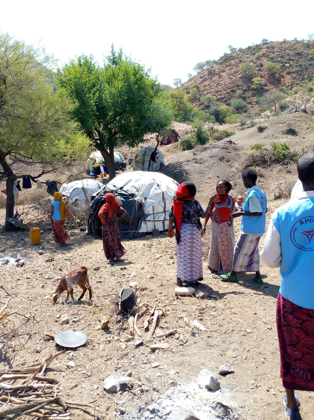
The role of the women extension worker in the health team is that she is more intimate with the women, girls and, having training in basic maternal health care works alongside the health worker, he providing the treatment as needed and she working the equivalent of a community social worker as described in 4.3 empowerment of women and girls to full development participation. As a community team, they liaise with the closest health center for all forms of referral as described.
Continuing from 2023, cholera ravaged communities up until October 2024. Malnutrition was remained confronting in all remote communities with high food insecurity while measles and whooping cough menaced areas of poor vaccination coverage, malaria and dengue fever being the other emergencies that were tackled.
- The Primary health program: emergency and ongoing community health service
Community health workers were deployed in daily activities of raising awareness and treatment of acute diseases as well as working in teams conducting campaigns to provide nutrition screening in known food deficit communities and conduct vaccination in highly remote communities. Their monthly reports for 2024 describe treating a total of 299,166 people over the 12 months of whom 63% were females of reproductive age. Of the treatments, 24.21% were for diarrhea; 11.65% for respiratory infection requiring antibiotics and 11.33% for malaria. Malaria peaked from the onset of the rains in July to December, the Region then being alarmingly low in antimalarials, bed-nets and mosquito eradication supplies. APDA therefore took on a specific project distributing 3,000 bed-nets, deploying health teams to the worst-affected areas with project-purchased testing and medications. To counteract diseases affecting the communities, reports showed a total of 1,420,936 messages were given of which 20.62% related to hygiene and sanitation peaking in the most severe cholera months of July to October.
Transmitted into Afar Region from neighboring regions, cholera demanding immediate response. APDA responded first in Teeru, then in Daali Fagi, Dawwe, Harissa in Afambo, Garani and finally among market – people in Sifra, ‘Adda’ar, Yallo and Golina. Realizing the toll on the community, APDA sent trucks loaded with health workers, soap, water purification as well as supplementary food within hours of notification. The latter was needed as malnutrition unfortunately accompanied the illness.
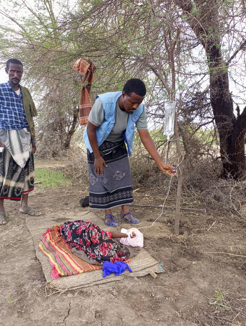
immediate treatment where community was affected saved probably hundreds from dying. Harissa, Afambo May 2024
Particularly Harissa in Afambo and Garani were hard to reach, intravenous bags sent in on camels. At one point, APDA had deployed 95 community health workers, 5 nurses and one health officer to quell the disease having trucked in soap, water containers and purification.
Malnutrition was constant throughout the year, a continuum of the effort in 2023, household food insecurity being the constant factor that acute malnutrition persisted along with diarrhea, measles and whooping cough. All areas are far from markets, distant from government or NGO food distribution. Affected households had little to no remaining goats and a high percentage were affected through conflict, the household head widowed, the head of household with chronic war injuries. These included communities along the Eritrean border in Bidu and Eli Da’ar, in northern Afdeera, the border hills of Konnaba, Wasama, rural ‘Aba’ala, Magaale, Erebti, Teeru, Garani, Kilaalu, Sibeebi, Gala’alu, Gawwaani – the latter 5 districts are particularly conflict – affected in southern Afar. In comparison, the parameters are slightly lower than that recorded in 2023 but still at critical emergency level: under 5 year old SAM (severe acute malnutrition) 2.8 to 3.8% of screened cases; MAM (moderate acute malnutrition of the same children varied from 33.1% on average to a high of 64.7% in the 3rd quarter while that of pregnant/ lactating mothers screened varied from 35.6% to 46.01%. Since no other assistance reached them, APDA purchased and distributed supplementary food (ground barley at 15 kilograms per month) to 6,643 mothers giving them 2 – month supply each.
Due to lack of logistic funding support, vaccination in 2024 was again in response to measles rather than prevention. The campaign as begun towards the close of 2023 was completed and a measles outbreak in Kilaalu and Sibaybi quelled with vaccination. A total of 6,597 children were vaccinated, APDA using its mobile cold-chain strategy to reach the community.
In home delivery service, 10,150 mothers were assisted. 6,608 were supported to have clean deliveries in their homes, the program providing a birthing set and the delivering TBA being supported by a women extension worker while a further 3,3395 mothers were referred to health centers or hospitals for higher care. A total of 10,150 mothers had received antenatal checking from health workers and women extension workers, 6,716 given the vital 1-week postpartum checking service. Of these deliveries, 15 were reported as maternal death, severe anemia, retained placenta being the main causes. Moreover, 41 newborn deaths were reported and 29 stillbirths, some associated with maternal malnutrition and anemia. The calculation for maternal death is then 150 deaths per 100,000 live births and 4.827 newborn deaths per 1,000 live infants. This achievement was only possible and can only be sustained by the continuation of the primary health team in the remote communities the program serves.
In the year, APDA assessed its approach of having waiting areas for mothers at risk in government health centers conducting an assessment of how 12 centers in the catchment area of the Barbara May Maternity hospital are functioning and how they can be built into strong local government – community institutions serving the needs of at-risk pregnancies until they deliver. Of 12 assessed, 8 need urgent support and APDA is processing this in terms of equipment, training and support management. A community group of 7 women are government and local leadership-selected to manage the actual traditional houses built as the waiting area, through income generation, feed the mother and her caretaker for the duration of her stay.
To make this program possible, APDA partnered with Barbara May Foundation, Australia; SONNE International Austria and Bread for the World in health development while Medecins du Monde, France; Diakonie Katastrophenhilfe, Germany; Barbara May Foundation, Australia; Birthing Kits Foundation, Australia; Oxfam GB; Ethiopiaid Australia, UK and Ireland; Fullife Foundation, Australia; Rotary; Anglican Overseas Aid Australia and individual contributions allowed APDA to achieve this massive health, WASH and nutrition emergency response program.
Written by Mohammad Nuha Hallo, APDA primary health sector head
- Barbara May Maternity Hospital (BMMH) in Mille
Now with 12 years of experience, APDA’s Barbara May Maternity Hospital in central Afar Region continues to provide rescue for some of the most difficult delivers (‘near misses’ as medically termed) as well as relief for women enduring long-term gynecological suffering. With 35 in-patient beds as well as running a twice weekly outpatients, the hospital sees women and girls from all zones in the Region as well as from neighboring Amhara Region where conflict periodically disrupts health services. One obstetrician and gynecologist; 17 nurses/ midwives; anesthetic, laboratory and pharmacy staff form the medical team. Along with auxiliary staff, the hospital aims to be a center of excellence offering girls and women culturally – sensitive care.
Delivering just 34 mothers more than the previous year, in 2024 the hospital conducted 682 deliveries of which 76 were emergency cesarians (11.14% of the total) and 61 were assisted deliveries (8.94% 0f the total). 71 mothers arrived with the baby in obstructed delivery positions. One newborn death was incurred and 8 stillbirths. In the final quarter, a mother of 5 children from a very remote area died 20 minutes after arriving in the hospital, her cervix closed with cervical cancer, the baby dead in utero floating squalidly in pus. This tragedy urges APDA to seek the means to screen for cervical cancer and provide immediate treatment.
With hemoglobin as low as 2.3 mm/Gm, 166 mothers required blood transfusion, 302 had malaria and 49 were admitted with retained placentas.
Most mothers in maternal emergencies come from extremely remote places. In the year, due to the generosity of a donor, APDA was able to mobilize a second ambulance, the two vehicles often making 2 three rescue trips in a day.
| One of many ‘rescue’ stories Eysa, now 25 years old from the rugged ancient volcanic crater of Unduru in central northern Afar was extremely excited to be pregnant having given birth to a stillbirth 5 years previously. To her horror and that of her family, when she went into labor and had pushing pains, literally nothing happened. Worried, they called the health worker. He and the local men hurriedly carried her to the roadside on a home-made stretcher connecting as they could on a mobile the APDA field coordinator. Fearing for her life, he called for the ambulance to meet the men, they having carried her for 5 hours. Four hours later, the ambulance driver rang fearing the worst saying that Eysa was writhing in uncontrollable pain – the health team begged the driver to continue the journey to the hospital. In the delivery room of Barbara May, it was apparent the baby’s hand and umbilical cord were protruding. Now at 3.30pm on October 26th, the only option for Eysa was a cesarian section – she had gone into labor the night of the 22nd. Eysa crying and the family in grave fear of what might be the outcome, they cautiously agreed. Then, after 20 minutes on the operating table, mother and baby met for the first time!! Eysa now says she could not be happier or more grateful for all the people who worked to rescue her baby son and her!!! |
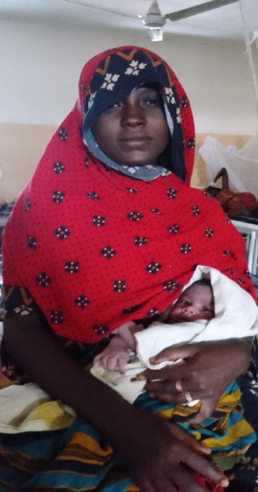
Proud mother Eysa 2 days after the birth!!
The twice weekly hospital outpatient antenatal clinics’ attendance progressively has increased from previous years, mothers taking up to the 4th visit. Moreover, being that districts adjoining Mille to the south (Kilaalu and ‘Add’addow) that were demarked in 2022 still do not have a health service, the hospital senior nurse has undertaken weekly visits to them providing antenatal checking using the portable ultrasound delighting these isolated, rural people. 3,621 pregnant mothers presented as 1st visit while 931 came on the 4th visit.
Being that newborn care remains a big challenge, the hospital continues to look for the opportunity to train a newborn care nurse and accommodate first-line treatment for newborns rather than referring them to Dubte Hospital.
Of the challenges in Afar maternal health that the hospital sees, eclampsia is persistent but anemia and malnutrition in mothers most bothering. The hospital is located 70 kilometers south of the Region’s only blood bank with mothers coming in with hemoglobin recordings as desperately low as 2 to 3 gm/DL urgently needing a blood transfusion to deliver with any safety. This then becomes a mad dash and in desperation, immediate donation is sort. 166 mothers received transfusion in the year and 66 postpartum hemorrhages were treated. Inpatient management of urine infection and hyperemesis was 368 patients and 227 respectively.
The hospital is in a preparation phase to establish a primary newborn care center aiming to avoid separating mother from baby by referring to the unit in Dubte hospital in the case of low birthweight babies and meconium aspiration.
Again, in the gynecology outpatients, numbers are somewhat higher than 2023, 2,914 patients having had their first appointment. 57 patients had surgical repair of uterine prolapse and 11 mothers successfully recovered from obstetric fistula repair, an overseas fistula surgeon accompanying the hospital gynecologist to make this possible. Of 14,064 inpatient and outpatients tested, five mothers tested positive for HIV and 339 tested positive for hepatitis B. Again, in the year, the hospital began to offer HPV testing for cervical cancer as well as providing the early treatment in the hospital – the need now is to take this service out into the rural communities since a previous testing had shown alarmingly high numbers in Afar reproductive women.
Barbara May Foundation, Australia is the main funded of APDA’s hospital with UNFPA providing some assistance in supplies and occasional training.
Written by Dr Omar Hussein, gynecologist and obstetrician, BMMH
4.2 Afar literacy, alternative education and hostel facility for children from remote areas
Indeed, the backbone of community development and a sustainable future APDA’s education sector provides the means whereby communities grasp and utilize change in health, female rights, livelihood adaptation and marketing. The engine of this is Afar literacy, literacy aiming that the student master reading, writing and basic numeracy and at the same time, gain opportunities of life improvement. APDA particularly promotes literacy within the program of stopping harmful traditional practices and gender-based violence that the community is able to see the inherent danger as well in program cooperative and microfinance that benefiting members are able to understand the market. In all taking six months through daily learning attendance, this has been and remains the only Afar can master their language in its written form. Having begun the program in 1996, 2024 was yet another year. Without a census, the literacy level in the society remains unknown but over the now 28 years it may well have reached around 45%.
From this, the program developed a program of alternative basic-education teaching to level 4: the curriculum is the government’s while the teachers, as with literacy teachers move when the students move in pursuit of water and grazing. Then realizing that students achieving level 4 in distant communities are most likely to return to their goat herd than continue learning, APDA has the strategy of hostel living in the school months that students go onto the higher grades in a government school.
This entire program is dependent on Afar language development that books and reading is available. While it was APDA that first used the Afar language in its written form with the start-up of the literacy program, the language still lacks strength in spelling and grammatical correctness as well as having an utterly limited literary base. Thus, APDA has writers and is trying to work with a voluntary group of educationalists and linguistics to strengthen the language in textbooks and formal use as well as accelerating the availability of literature. Having a printing press, the organization is aiming that books and booklets are available and sold at the community level, seeing that Afar history, traditions, live skills learning and stories are preserved for all to enjoy.
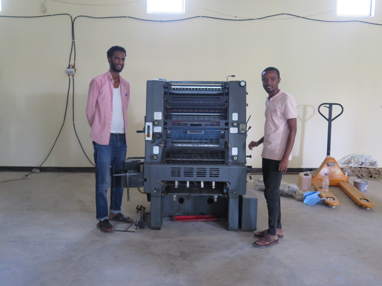
APDA’s printing press run through its social enterprise, Karma in Logya
Afar literacy:
Implementing in 132 sites of 14 districts, the program taught 18,503 people Afar literacy in the year. Of this, 62,14% (11,498 were females), a huge effort made to assist mothers, grandmothers and other females to gain the confidence to voice their issues and needs, to enter income generation and to fully commit to ending harmful practices. The continue to learn from the five primer books Dr Enid Parker wrote some 50 years ago but it is for them that APDA has the printing press that they will continue to develop their literary skills and take control of their future with all the challenges of world change and associated natural and human disasters. All the program teachers were trained in 2024 improving their skills in pedagogy as well as their individual knowledge level, as possible, grading teachers up to teach alternative basic education. In the Region’s relatively new Zone 6 where Issa/ Somalis were driven off Afar grazing land and the Awash roadway in 2022, there are 40 sites. There the perpetuating fear that conflict could break out again challenges learning as well the actual under-development of the 4 districts since they have no protected water supply and in in many cases, water collecting takes up the entire day for the household women who do this. The above photo is learning in Kilaalu close to the possible repeated frontline where water is scarce. As before, in each site, community development committees composed of the community elders (men, women and youth) take care of the daily education management as to where and when to learn as well as learning continuity. Under their guidance, education drop-out is 2 to 3%.
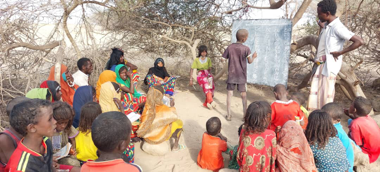
Alternative basic education:
The alternative basic education (ABE) program follows government curriculum providing for the student to learn as far as level 4 in five subjects, Afar language being the vehicle of learning. In the year, the program reduced to 25 sites teaching 1,728 students as of December 2024. Four program teachers graduated from just teaching literacy to being able to teach ABE. Students completing level 4 are encouraged to secure their ongoing learning in government schools in their respective vicinity. Again, drop-outs in the year were minimal and female participation is 46.64%.
Early childhood learning through playing:
As of mid-2023, APDA is implementing a project piloting pre-school within a wider consortium. Being the project provides school food for the 4 to 6-year old, the 6 classes in government schools of Wasama and Barhale have attracted almost twice the planned number, children learning through seeing, hearing, touching and making objects of learning. As far as it is possible, APDA is using the Afar culture as the vehicle of learning.
Hostel student support:
Since taking the students, APDA is continues committed to the 183 students in 4 towns who are supported to live close to a government school that they complete grade 12. 2024, was not much different to 2023 in that those graduating from grade 12 to tertiary education was only 33 out of 4,467 students who sat the exam. Thus, for APDA each of the hostel students are precious and overall, the organization vision is to be able to establish more hostels with tutors and support.
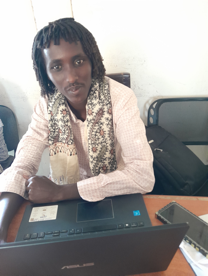
Ali, born in Hubbiyokalo, Geega, Dubte woreda. He learnt from grade 5 to 12 by living APDA’s Logya hostel and is now in the final year of an engineering degree in Samara University wanting to serve his people with his knowledge.
Book writing and printing:
Having a group of volunteer linguists and writers as well as employing a writer, APDA is writing and publishing books for all ages and all sectors of the society including children’s books taken from the historic, cultural stories.
The education program has contributors as follows:
Banyan Tree Foundation, USA supporting 127 hostel students
Kinder in Not, Germany supporting Afar literacy and alternative basic education
Ethiopiaid Australia in supporting 10 literacy teachers as part of stopping harmful practices
UNFPA supporting 30 girls and women’s friendly spaces (GWFS) where Afar literacy is taught in Yallo, Goolina and Uwwa
Rogers Foundation, USA supporting 10 teachers in Geega, Dubte woreda
Ethiopiaid Australia facilitating the contribution of the Neilson Foundation contributed the printing press and support 20 education sites in southern Afar Region.
Respect for Change from Belgium supporting literacy enabling community commitment to stopping harmful practices;
Save the Children supporting a project funded through USAID and LEGO for pre-school learning
Written by Ali Dardar Ali, education sector head
4.3 Empowering Afar women and girls to be full development participants
Fully cognizant of its responsibility to continue the struggle that Afar females are part of community development emphasizing their need of safety in reproduction and involving their innate capability to nurture children, APDA has worked hard in 2024 to facilitate changes that this demands. In fact, through the enabling of the community clan leadership, a historic breakthrough happened as of a conference held on December 25th 2024. Having met also in 2022 and 2023, 84 representative clan leaders of the entire Region confirmed and inaugurated that any tradition harming people inadvertently should be stopped, starting with female genital mutilation. Thus, FGM is now illegal in clan law and has an instigated punishment. It is now possible and probable to stop FGM from the Afar society but this then requires accelerated and vigorous effort in the community to a) rid the community of illiteracy that allows the society to cling to the practice and b) provide ground-level monitoring that the newly – established clan law is followed, the latter being the daily effort of community health workers and women extension workers employed from the community.
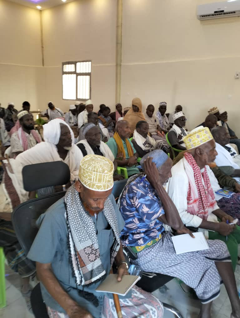
A second breakthrough APDA has achieved is an agreement between the organization and APDA that the habitual practice of chewing the amphetamine leaf, khaat must stop. Not grown in Afar but imported from adjoining Regions, khaat is a leaf that literally inebriates the brain to neglect household and personal responsibility, literally consumes the household economy costing some hundreds of ETB daily for one person, shrinks the intellect to mindless behavior and, in the end, is probably the greatest cause of domestic abuse as well as hunger. Markets are in roadside towns but it is taken to the rural communities. The Regional President has endorsed the need to stop it and has his campaign to stop his cabinet members and employees. APDA is progressively working with communities that they see how this undermines the right of the child and the mother using the slogan ‘since the person who chews khaat is destroying his house, he has no right to ask assistance and will not receive it’.
The ideals of this sector were fully integrated in each of the program sectors in the year, women and girls being the core beneficiaries of primary health, Afar education, community economic development and the move toward varying livelihood and household diet as described below. 34% of APDA’s employment are females, the majority having rural positions as women extension workers and their female team leaders. In 2024, APDA deployed 264 women extension workers, perhaps better described as community-based social workers. From their own community, they worked daily as the deterrent of harm to females and the support of life skill empowerment enabling women to manage their lives and their households. They then fulfilled the role of the internationally – expressed desire to see protection of the most vulnerable in the community.
Women extension workers as agents of change, the Afar version of rural social workers:
In the year, the 264 women delivered a total of 741,922 messages of awareness, demonstration as well as counseling as per their monthly reports across 29 program geographic areas, they with their counterpart mobile primary health workers, walking house to house through their designated areas. From health awareness to maternal health care and child care, these women are able to counteract harmful traditions inaccuracies in traditional thinking regarding reproductive health given they are addressing the community they grew up in and have themselves experienced all that harmful traditions inflict. Indeed, in assessing one rural community for FGM in 2024, of 2,184 girls under 5 years, almost 20% had no cutting at all while the remainder had what the community describe as ‘a lesser cutting’ – progress is being made.
In continuation of the strategy initiated in 2023 of women extension – led ‘Girls and Women’s Friendly Spaces’ (GWFS) in a total 30 kebele sites in Yallo, Golina and Uwwa of Zone 4, APDA has seen this provides a protected and highly effective place for community women and girls to resolve their issues, share empathy and build confidence. This is evident in the large number of women who learnt Afar literacy and community economic skills in these centers as well as them working to track and assist women and girls surviving gender-based violence. The local governments and the respective traditional leadership are very positive of the value of these centers emerging as an example to replicate in other Afar districts, the communities determined to continue this service even as the project completed at the close of 2024.
With her multi-faceted role, the woman extension worker is skilled at understanding when and how the community are engaging in traditional harmful practices relating to female genital mutilation (FGM) as well as forceful marriage practices; daily hygiene, sanitation, child-raising, nutrition in the house; anxiety of a abused woman/ girl; how to undertake simple petty trading as well as home-care for the pregnant and delivering mother. Her annual refresher training, her links to the traditional and government leadership; her partnership with the mobile health worker and the literacy teacher in the community as well as having 5 trained traditional birth attendants with her makes her the pillar for community support. Through monthly reporting, it is clear that around 25% of their effort is on stopping harmful practices and GBV while working with the community development team daily to stem off disease outbreaks and support pregnant mothers. Women extension workers therefore played a significant role in the support of 10,150 home deliveries as reported above. In summary, while the role is peculiarly APDA’s it needs to be institutionalized in the local community as is that of a government health extension worker or a teacher.
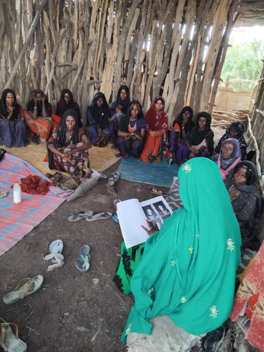
Training women extension workers in Teeru, 2024
Traditional leaders, fathers of the community:
The clan leader and his counterpart, the religious leader are highly esteemed within APDA’s program as the custodians of community morality, the upholders of traditional governance and law that has been Afar social ‘glue’ for history. Therefore, as in previous years, in each defined community, the program set up and sustained a community development committee consisting of the clan and religious leader, leading women and leading youth (total of 7 members and mostly 3 females and 4 males). They were trained as an annual means of recognition as well as securing the link to the program, they leading their respective community into stopping harmful practices and GBV among other positive actions. This committee therefore was a strong support to the women extension worker, backing her effort of awareness and mitigation.
As mentioned above, clan leaders have endorsed their role in punishing those who perform FGM speaking of crime of rape as punishable under the government law, their role being to actually catch the offenders and turn them over to the law.
The role of youth
With 75 of the program sites in the year, APDA continued the experience of coupling youth in a voluntary role (a male and female) with women extension workers that their view point is acknowledged and respected in terms of stopping harmful practices, choice in marriage. This continued to prove effective in 2024, youth combining effort with traditional leaders and working to alert government authorities of possible cases of abuse as well as protecting girls in completing education.
Those partnering to achieve these results include
UNFPA providing support to stop harmful traditional practices and GBV through GWFSs and community – linking activities and training
Ethiopiaid UK, Australia, Ireland supporting the stopping of harmful traditional practices and GBV
Barbara May Foundation, Australia supporting women extension workers in maternal health team
SONNE International Austria supporting women extension workers in the maternal health team
Brithing Kits Foundation Australia, supporting women extension workers in the maternal health team
Respect for Change, Belgium supporting ending harmful traditional practices
Ethiopiaye, Switzerland supporting ending harmful traditional practices
Written jointly by Amina Ibrahim, Muusa Mohammad and Ali Yassin, Gender Officer, Harmful practices awareness coordinator and youth coordinator respectively
4.4 Combining Community Economic Development with Food Production
While APDA’s program societal goal (strategic plan 2024-28) states that ‘Afar have opportunity of improved social and economic livelihood appropriate to their defined need is attainable and sustained in targeted Afar pastoralist communities’ this must be seen through the prism of household food security, the very element that is under decline. Challenged by the alarming reality on the ground, in 2024, APDA has learnt and adopted a number of deliberate changes:
- The indelible link between the need for livelihood diversity; market management and, in the house, diet diversity enabling household economy and human capability growth
- Fulfillment the productivity needs of the animal herd.
- The advantage of linking Afar communities across the Region in production.
- Practiced – based evidence of that female productivity is dynamic and blessed by the community acceptance.
- Community – generated projects that are implemented and managed by the owners of the land is the ideal APDA wants to adopt for the entire program.
Thus again, all the implementing sectors of the program link in the effort to succeed. The other principle APDA is following is to ‘leave no community behind’, meaning even although the actual project is over, to continue to link with, mentor and support efforts of previous years’ projects that, as far as possible, the community gain is consolidated as well as being shared in adjoining communities and that ideas link. In 2024, much effort was made in revisiting and reviving past projects.
- Community training toward livelihood revival and marketing
Uddudayto, a plot on the outskirts of the town of Logya is now established as the organization community training center for horticulture and marketing. With its own 9 – hectare demonstration plot, it has given 60 days training to each of 24 community groups (each group of 15 women and 5 men) in horticultural techniques as well as the basis of income generation through marketing. These 480 once pastoralists have now begun their own food – crop growing in far – flung geographic areas ranging from Daalol on the border with Eritrea to Dullassa, Afar Region’s furthest southern district. All have access to water for irrigation and now as agro-pastoralists have learnt skills of land preparation, seedbed and crop rotation. They remain within APDA’s linking program, benefiting from seed and seedling access, transportation support and marketing/ cooperative legalization. Too, urban youth from Samara and Logya voluntarily learnt from the center that they too can grow some of their household food supply.
The center is developing a cooling room that the community can store food crops as necessary balancing production with market uptake to limit crop wastage; has a plant nursery and looks to establish a seed bank. Connected to the Dryland Faculty in Samara University, the center gains from training expertise as well as the research of appropriate seed production in the challenging Afar environment. There has been an immense struggle to pump plant-friendly water to the demonstration plot, the onsite borehole producing water over 50° centigrade. A cooling cistern was constructed, meantime 4 thermal pumps burning.
Ongoing, APDA aims to continue providing training for the pastoralist/ agro-pastoralist community as well as seeking out more ways to improve the sustainability of food crop-growing including incorporating cooking demonstration kitchen.
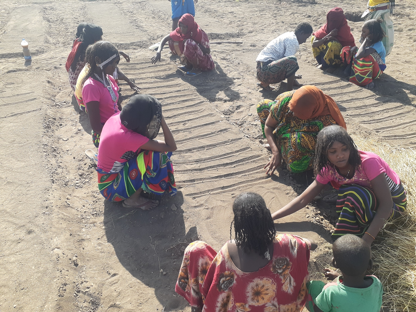
learning to mark out seed beds in Uddudayto training center
- Food crop production; eating and selling locally
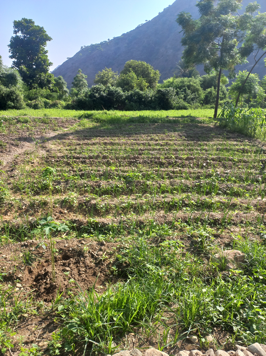
Now with 36 community groups of around 50 people – dominantly women: 6 in Daalol; 2 in Konnaba; one in each of Erebti, Afdeera and Magaale; 2 in Sifra; 3 in ‘Adda’ar; 2 in Mille; 2 in Geega; three in Afambo; 5 in Garani; one in each of Sibaybi and Kilaalu and 8 in Assa’ita, green and yellow vegetables as well as bananas, pawpaw and mangoes are slowly emerging into the Afar diet. The process to establish 4 horticultural groups on the fertile soil of Hanruka in southern Afar is underway. Insisting on the milestone ‘1,000 days window of hope from inception to the child’s 2nd birthday’ as UNICEF advocates and as is the basic theory of the ‘nutrition – sensitive agriculture’ project started in the 8 groups in Assa’ita, the program is eagerly taking this learning through its primary health and women extension network to where child – growth stunting is devastating the future of the Afar people.
In the year, the project is supporting Afar agro-pastoralists of Aynab in the hills of the Tigray border in Daalol as well as their brothers in Simbaali where a river diversion to prevent flooding was needed that they are now part of the program.
Moreover, through the innovation of GIZ, pearl millet was first grown in Sifra and then the seeds introduced in Afdeera, Magaale, Garani and Assa’ita – Daalol farmers have used this plant variety taking the seeds from Yemen for now 150 years. The advantage of pearl millet is that it only takes 70 days to mature, needs less water, is plant disease resilient and far higher in protein and other nutrients than maize.
Again, kitchen or home gardens are now introduced to 250 families in Konnaba and 250 in Addow Kwa’a, Daalol as is the practice in 500 households of the Assa’ita project.
The program is obliged to establish solarized/ fuel water pumps to retain irrigation water 12 months in the year while nurseries accessible and adjoining to these production sites are needed: some established and some in process. Plant pests in the Afar are prolific including locusts. Through the nutrition sensitive agriculture project, a field visit to India has taught the program locally – made pesticide based on 3 tree leaves and cow urine as well how to make composting fertilizer similarly through local plant residue and cow urine. These methods are being adapted across the program, the training center focal to demonstrating and distributing knowledge. The issue of birds and other rodents eating the crops need to be
- Community food supplying cooperatives
The program now supports a total of 40 community cooperatives that involve in multipurpose selling to their respective community focusing on bringing in food that it is accessible and, as far as possible, protected from to market inflation fluctuation. Having three trucks allocated, the organization offers the cooperatives transport support at the cost of the fuel rather than hiring trucks to bring from the supplier. All cooperatives have a ground-level membership of 50 people of whom a minimum of 65% are female, women being part of leadership. Assessing cooperative performance in 2024, the community economic development sector concluded that in several incidents, all 50 members were not active or actually benefiting. Based on this, a new cooperative structure of formation and management is now in circulation to all groups that includes traditional leadership as advisory to the group, as well that the members work in groups of 5 to 7 in income generation having rotating responsibility to the cooperative leadership. Moreover, APDA is in process to facilitate government audit of cooperatives enabling them to increase membership as well as form into unions.
In 2024, 4 new cooperatives were trained and given start-up in Daalol and a further three fishing cooperatives in Afambo harvesting fish from Lake Gammerie and Lake Afambo. They clean and freeze the fish selling some locally but mostly to Samara and other urban markets. Aside from the northern people, Afar are initially reluctant to eat fish. A further milk-producers’ cooperative is to be formed utilizing the roadside – sold milk from cattle between Logya and Samara. The plan is to make it value – added into yoghurt.
- Microfinance and the market
While over the years, APDA has established microfinance with women living in poverty particularly in the conflict – affected districts, in 2024 a further 4 microfinance groups were added. All members are trained in basic income generation and finance planning as well as how to manage their group that returned loans go onto another needy household.
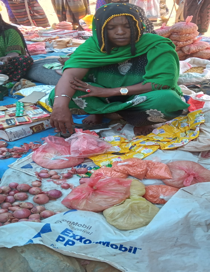
Microfinance beneficiary sells in Yallo market as well as her home
In Magaale, Konnaba and Yallo markets, the petty trade of vegetables and household goods is now almost all Afar women. Prior to the northern war, merchants from the adjoining Regions controlled the sale.
Currently APDA is monitoring the loan distribution in six communities, others previously established handed over to the respective government microfinance expert. Loan defaulting is not the experience of the program.
- Rehabilitating rangeland to productivity
Completing in 2024, the water spreading weirs in Sifra and Awra are spectacularly productive, even green in drought. In Ta’abuyye and Giraaro of Sifra, communities are growing food crops as well as fodder while in Lee Kora 2 water spreading weirs are now providing much needed fodder grass. All four weirs are backed with hillside terracing and gully closure/ treatment ending the erosion that came off the Ethiopian highlands. The communities are formed into productive cooperatives.
Then in the drought-prone district of Kori, the land is again rehabilitated through dry stone measures of terracing and gully closures in Daaba with a water spreading weir on the seasonal river in Guyah. In all, grazing shrubs are preserved from dying and drying and grazing land is restored to the 3,000 hectares. The communities carried out all construction through cash for work.
- Water sources
In 2024, the water scheme damaged under conflict in Faaro, Magaale was rehabilitated as well as two schemes in Kayni’e Koma in Kilaalu getting water storage and distribution construction. In all, over 4,000 people received safe access to clean water.
- Veterinary service
The program’s goal is that veterinary treatment should be available locally that the herd does not die in disease outbreaks and that animals are sold as healthy as possible awarded the best possible price. To that end, APDA now has four veterinary cooperatives, the 4th started this year: one in Yallo, Magaale, Konnaba and Erebti, the members being government – trained local paravets and they having a drug vendor that has access to replenishing veterinary supplies. In 2024, two of the cooperatives received start-up medication, all having been trained in the basis of cooperative formation and income generation and how to exact payment from the animal owner according to the treatment given. All four cooperatives continue to offer community service, clan leaders overseeing their function.
Beyond this, the organization continued to offer emergency animal treatment as alerted to, where possible the community paying cost price of the medications so that the organization supply can be replenished. This service covered almost all woredas over the period of the year.
Totally excitingly, the organization is now in a position to break through the dilemma of herd loss in drought periods and consequential long periods without household milk since through visionary generosity, APDA has acquired an animal feed production plant. As with the printing press, under its social enterprise, Karma, animal feed will be produced for emergency as well as to build resilience into Afar Regional herding. APDA aims that through community cooperatives, animal feed will be sold alongside household food locally that the family plan to keep their milking goats in top production, market fattened animals and consequently secure their livelihood against drought loss and lack of food. As well, the plant will sell commercially returning the gains to further strengthening livelihoods
- Green energy
Now completing 2 years of implementation, APDA has trained 50 people in solar scheme operation and maintenance, training courses taking 3 months. Qualified people are now capable technicians and are to be equipped to undertake solar set-up and repair. This is all part of the Green energy initiative of Ethiopia. A further 70 people will be trained in the Assa’ita TVET, APDA’s hope is to localize technical ability that the solar schemes of the Region remain in working order.
- Community – driven approach to projects: balancing usage and land protection
Having drafted the proposal in 2023, APDA began to ‘Reverse the Flow’ in 2 and now a third community in Afar Region. The concept while not before seen/ noticed in the repertoire of the donor community, is the core belief of APDA: the community are the drivers of their own future, identifying the problem, the solution and implementing the project APDA being the conduit to the Netherlands government. Having sat and listened to the community needs, aspirations and abilities in Musgiid kebele of Sifra and Burka in ‘Adda’ar (Ni’in Lee site) the two communities have now articulated their respective plans of environment protection, rehabilitation and sustainability. Having now established their own legality to receive the fund, both communities are on their way to implementing riverbank and forest rehabilitation and protection alongside riverside farming and group marketing. Similarly, a community in Yanguddi are working through the same opportunity.
APDA has a hub to support them within the office program as well as a local hub in each of the woredas, a hub leader overseeing the process.
Those partners supporting APDA in this include
SONNE International, Austria: supporting the horticultural and marketing training center, Uddudayto
Bread for the World or PADD, Germany: horticultural and marketing groups in Garani
Diakonie Katastrophenhilfe, Germany: Water scheme repair, veterinary cooperative support
Welthungerhilfe, Germany: cooperative support land rehabilitation, water scheme rehabilitation
Horn of Africa Regional Environment Centre and Network, Addis Ababa: natural resources management, income generation support
Sign of Hope, Germany: Horticultural and income generation support
Anglican Overseas Aid, Australia: Horticultural and income generation support
World Accord, Canada: Horticultural and income generation support
Ethiopiaid UK: emergency veterinary support, establishment of animal feed production plant
Adventist Development and Relief Association, Ethiopia: Green energy initiative, solar scheme training
Netherlands Enterprise Development Agency (RVO): supporting community initiated and implemented projects to protect the natural environment and to revive the livelihood
Danish Church Aid: Horticultural and income generation support
Written by Mohammad Ali ‘Adow, community economic development sector head; Macammad Ahmad Isse, Livelihood sector head.
4.5 Peace and Reconciliation
In a consortium with NGOs in Somali and Oromo Regions, APDA continued to implement a peace project aimed at stopping land and resources conflicts around the Awash National Park as well as between Afar and Arbuba in Dullassa woreda. The year was busy in bringing people together to discuss and negotiate agreements punctuated by cattle raids and actual confrontation. Overall the interest to end conflict is growing but the youth are providing a challenge of lack of direction.
Supporting funder:
Bread for the World, Germany
4.6 Emergency response activities
APDA’s emergency response is interwoven in all the mentioned sectors, the community directly alerting the organization of urgent need to respond and APDA literally working through this within in hours. Emergency alerts were communicated to the pertinent government office, were given immediate reply as to what the organization could afford and, as needed, a plan for deliberate emergency intervention made.
Cholera, animal diseases, measles and malaria outbreaks were among the emergencies APDA responded to along with the ongoing malnutrition as mentioned in the primary health sector. Following an assessment of the status of conflict – displaced people in Zone 6, a project to relieve the shelter needs in Yanguddi, Sibaybi and Add’Adow was agreed to in November 2024 but not as yet implemented.
Immediate action was made possible by the amazing response of so many individual contributors as well as the following institutions:
Sign of Hope, Germany
Diakonie Katastropenhilfe, Germany
Welhungerhilfe, Germany
Ethiopiaye, Germany
Mennonite Central Committee, Ethiopia
Ethiopiaid Canada
Ethiopiaid UK, Australia and Ireland
Action Not Wenden, Germany
Rotary Clubs in South Australia
Supporters of Barbara May Foundation, Australia
Written by Usmann Hallo, Emergency response focal person
4.7 APDA’s Advocacy Drive
With the peculiar nomadic, dominantly herding lifestyle of the Afar people and in a Region threatened with conflict on all borders, APDA is constantly acting to voice the community situation and need to cluster meetings and through OCHA. However aside from this, the organization continued to engage in a five Ethiopian local NGO forum networking to 7 other countries advocating for greater effectiveness and timeliness in humanitarian emergency response based on the world Grand-Bargain Agreement, 2016 through local actors. The project has provided the 5 Ethiopian LNGOs with greater implementing and management capacity to align with bilateral donors and has performed joint advocacy in Ethiopia for improved LNGO voice and involvement in the humanitarian response.
The project funder is Welthungerhilfe, Germany
The year in summary:
Having concluded 2023 with the statement for stronger implementing strategies to meet the demands and challenges of such a critical Region, APDA has formulated sector – level strategies aiming for ongoing, dynamic review. To that end, APDA did define itself better in 2024 through its 30th year anniversary in May 2024 as well as in documenting the need for mobility and learning flexibility in the program.
Overall, there has been progress toward laying the ground-work for sustained livelihood and therefore household food security. The thousands of households assisted were primarily selected because of their abject poverty. For them, there is now release and relief. It remains to pass this on to more and more households through multiplying the benefit as well as working toward securing the community-based development team as the third strategy beyond the Ethiopian – accepted urban/ peri-urban strategy. Increased literacy, lowered maternal death and the traditional leadership’s willingness to categorize FGM as illegal are all signs that APDA’s strategy is legitimate for the 45% of people who live in the 65% of geography that has no ready access and currently no formal services.
Samara, 19th May 2025
Endorsed by Ismael Ali Gardo, APDA Executive Director
