Having sunk into utter drought desperation of thirst; animals dying from dry pasture following the failed rains of July/ to September, rain fell!! Substantial rain in most parts, rain directly across the dry belt through the night of November 11th bringing back hope and life to vast dried grazing plains; the rain, the Afar say of a long-forgotten rainy season called Dabayba – truly amazing!!!! Rain soaked much of the dry central and northern districts aside from northern Eli Da’ar and Bidu on the eastern Eritrean border then falling short of moving south beyond Mille, southern Afar remaining dry including the
Before
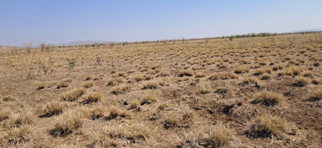
Drought devastated pasture in October where 100’s of cows Would normally graze at this Time.
After
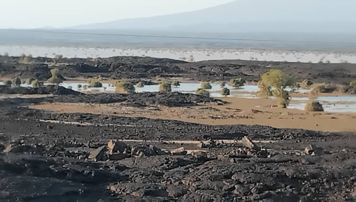
Afdeera black lava flats, November 16th, the notoriously – named ‘hottest inhabited place on Earth’
with rain water pools that in a month will grow clumps of grass
This has spun APDA into a gentler gear:
- There are two districts from the 4 that had demanded water trucking that still require support: 5 sub-districts of Bidu on the Eritrean border and Kilaalu just south of Mille where water trucking needs replacement with water point/ scheme development.
- Animal feed is remains needed but, in a month, or so, the emergency of this distribution will evolve into households buying at cost price to boost household milk production and fatten marketing animals
Best of all, we are energized again to speed up the strategy toward ending food insecurity with dam constructions as planned; cooperatives that sell food to the community at wholesale cost; boosting veterinary support within the communities aiming to make positive gains as the household herd recovers.
Unfortunately, however, the current extreme situation of malnutrition cannot be overlooked: having screened malnutrition in highly remote communities of 20 districts in October 2026, 44.86% or 21,716 pregnant and early – lactating mothers were found malnourished – double September’s assessment results. 4.62% or 2,879 children need rescuing from severe acute malnutrition. These awful figures will only improve with food in the house: as critical as the effects of drought are, so is the unaffordable and inaccessible market dragging families into this devastation. Still to feed an average family of 6 members just with wheat or maize flour bread for 15 days demands the sale of a minimum of 2 goats. Herd depletion in 2026 has been outstanding leaving the majority of households with less than twenty remaining goats; additional destitute households leaning on others in the community to survive. Let alone the fact people eat a mono-diet without nutrition in the absence of milk/ sufficient milk in the house, they cope restricting eating to once daily, at the very most, twice daily.
Thus, on the emergency side, APDA needs to continue water trucking for the Eritrean border communities and communities south of Mille where rain did not reach; keep up emergency animal feed distribution till grazing has rejuvenated and support this overwhelming number of malnourished mothers and children, particularly in remote communities lest mothers die giving birth from insufficient hemoglobin to provide the oxygen for the last push and children under 5 simply succumb, totally lacking resistance having such critical protein deficits. While the organization now has protein-rich supplementary food to support 500 mothers for 2 months, the need for this is critical. The rain that fell may come into effect with more milk in the house by late December lasting through to February/ March 2027. The next main rains are described as ‘short rains’, late March and April producing perhaps a storm or two.
The other commodity of survival being peace, from the reported 8- day fighting of September 23rd to 30th, there has been no further outbreak in northern Afar from Tigray but the border communities live on high-alert of the possibility of the two countries fighting, restricting access and movement for community life. Right now, APDA’s truck is assisting people to return to their home areas in the Tigray border of Magaale having spent since 2022 130 kilometers from their home for fear of the Tigray armed forces.
Producing for community access and eventual development sustainability:
APDA’s enterprise activities having an animal feed production plant; a soap – making machine and a printing press are now really coming into their own in terms of being part of the solution: affordable and very high quality concentrated animal feed is now assisting the most desperate households to have an sustain a milk supply despite drought conditions; cheap and very usable soap is enabling the poorest households to engage in disease-preventative hygiene and books in Afar are enabling/ exciting those who learnt literacy to take on into other life-skills including breaking the cultural barrier of market inertia. Indeed, concentrated animal feed IS the community-demanded answer for inflicted drought losses; the aim being to reach the entire Afar herding community with accessible and affordable animal feed that milk is available 12 months in the year regardless of the rainfall.
Instructed by clan leadership
Winding up APDA’s endeavor to take direction from the clan leadership of how their respective people can endure the layers of actual and threatened shock, the organization met with the 42 members of the clan and government leadership on November 14th representing Daalol, Konnaba, Barahle and Afdeera on the Afar – Eritrean border to Magaale including Erebti, Abaa’la and Wasama, the Region’s 8 most northerly districts. In unison, these senior men described a distorted and uncontrolled market as the overriding factor of household food insecurity, drought effects described as durable through accommodation. Commodity costs in northern Afar are twice and more than that of the center of the Region; their traditional marketing dependence on Tigray all but cut, distances to wholesale markets are very far and fuel in the north sold through an exploiting, irregular market. With at least 20 community cooperatives in the various districts, they recommended they unite in collaboration and that APDA support the mergence of storage and transportation hubs to avail these groups with regular supplies; they themselves expressed need to link inter-district in trading and overall support.
This final conference now has established direction for APDA going into 2027; the meeting in central and southern Afar endorsing the need to continually access animal feed to preserve the herd and to mobilize their respective communities to excavate rainwater harvesting reservoirs in preference to deep wells that often produce salty and steaming hot water; the actual scheme subject to breakdown and long periods unrepaired due to affordability issues.
2026: preparing for 2027
Despite multiple crises of conflict, drought, flood, locusts, earthquakes/ volcanic eruption, market manipulation and conflict, APDA is planning to further energize the program’s 6 pillars:
- Afar language development; mobile education and hostel-living that students go onto tertiary learning;
- mobile primary health emphasizing maternal and child-health linked to an obstetric and gynecology referral hospital;
- empowering women and youth to enjoy rights as well as be participants of development;
- community economic development;
- pastoralist and agro-pastoralist livelihood and finally
- peace and reconciliation.
To this end, the organization will continue to dialogue with the local leadership; with the government and with yourselves as to how to enable the mobilization of community development that the effects of shocks diminish with community response.
An overall report of the program in 2026 will be published in early 2027 aiming to spell out how the process is evolving. As a microcosm of the overall scheme of world change, Afar look forward to playing their role and reaching their ambitions.
